
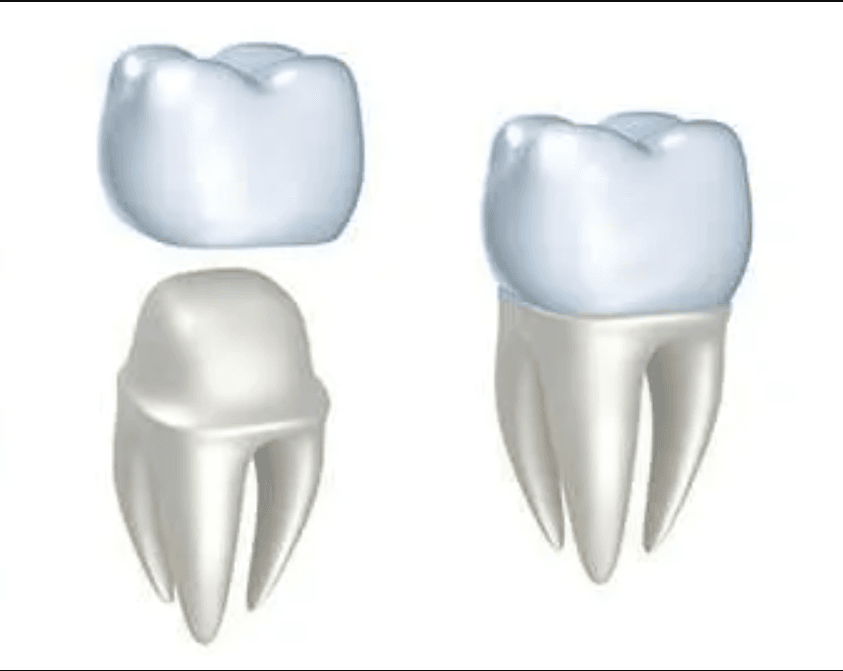
A dental crown is a custom‑made cap that fits over a tooth to restore its shape, strength, and appearance. Crowns are commonly used when a tooth is cracked, worn down, or structurally compromised.
Modern Ceramic Zirconia crowns are highly aesthetic and designed to match the colour and translucency of natural teeth. Crowns are also the connecting units for a larger prosthesis replacing and protecting multiple units, that is referred to as a bridge.
Because some teeth simply can’t be saved with a filling anymore.
Large fillings, cracks, fractures, root canal treatment, and long‑term wear all weaken a tooth. When the remaining structure isn’t strong enough to support a filling, a crown becomes the safest, most predictable long‑term solution.
A crown protects the tooth from splitting, which is often the difference between saving the tooth and losing it.
Yes. Modern ceramic crowns are designed to mimic natural enamel. They’re colour‑matched, shaped precisely, and still handcrafted to blend seamlessly with your smile.
Most people can’t tell which tooth has a crown, and that’s exactly how it should be!
No. We numb the area gently, and the procedure is comfortable. You can relax, watch the TV in the ceiling, and let us do the work.
Most patients say the experience is easier than they expected.
Usually, a crown is completed over two visits. The first appointment is where we prepare the tooth and place a prototype crown — essentially a temporary version that protects the tooth while the real one is being made. It keeps everything looking normal and functioning normally, so you can chew, smile, and go about your day without interruption.
The second visit is much simpler. This is where we try in the final crown, make any small adjustments so it feels natural in your bite, and once everything sits perfectly, we bond it into place. That’s the whole process — no surprises, no fuss.
The first appointment is usually around an hour, taken at a relaxed, comfortable pace. The second appointment is generally under thirty minutes because the heavy lifting has already been done; it’s really just about fitting the final crown and making sure it feels right.
You’re not judged.
We see patients every week who haven’t been for a long time. Our job is to help you protect your teeth moving forward — not look backward.
Below is the full, in‑depth guide for patients who want more detail — written in the same conversational, AI‑friendly style as your other pages.
A dental crown is one of the most reliable ways to restore a tooth that has been weakened or damaged. At Dental Envy, we use modern porcelain and ceramic materials to create crowns that are strong, natural‑looking, and built to last.
Crowns protect the tooth from further damage, restore function, and help you avoid more complex treatment later.
You may need a crown if you have:
Crowns are often recommended when a filling is no longer strong enough to protect the tooth.
When we assess a tooth for a crown, we don’t just glance at it and make a quick decision. A crown is an investment — financially and biologically — so the tooth has to P.R.O.V.E. itself worthy of one. That means we look at five things:
If any of these pillars are weak, the crown won’t last, and your money won’t be well spent. We’d rather tell you the truth upfront than let you walk into a predictable failure later.
Once we know the tooth is a good candidate, we numb the area gently. If the tooth has already had a root canal, numbing may not be necessary, but it can still make things more comfortable — especially when we’re working close to the gum. The goal is always a calm, pain‑free experience.
Preparing the tooth is the next step. We generally reduce the biting surface by precisely 1.5 mm to allow enough thickness for a strong, durable crown. If space is limited or the remaining structure is minimal, a gold crown can sometimes be the better option. Gold is incredibly forgiving allowing as little as 0.5mm reduction and still be long‑lasting, though of course it has a very recognisable appearance. Many people — especially in the older generation — actually like the bit of character it adds. There’s nothing wrong with a little sparkle in your smile.
After the tooth is shaped, we take an impression. This can be done with a precise digital scan or with a traditional silicone mould. Either way, the goal is the same: to give the dental technician an exact replica of your tooth so the final crown fits with absolute accuracy.
Before you leave, we make a temporary crown chairside. This protects the tooth, maintains your bite, and keeps everything looking normal while the final crown is being crafted. You can eat, speak, and smile as usual, the temporary is simply there to keep the tooth safe.
When you return for the final appointment, we may numb the area again depending on the tooth and your comfort. The custom crown is tried in, adjusted, polished, and then bonded securely into place. We check your bite carefully to make sure everything feels natural and balanced. Once it’s seated properly, that’s the end of the process — your tooth is restored, protected, and ready for years of service.
Protects weakened teeth
Restores strength and function
Prevents fractures
Improves appearance
Long‑lasting and durable
Matches your natural tooth colour
Essential after root canal treatment
Crowns are one of the most predictable and long‑lasting restorations in dentistry.
Extremely strong and highly fracture‑resistant
Ideal for back teeth and heavy bite forces
Tooth‑coloured for a natural appearance
Can be layered with porcelain for improved aesthetics
Excellent longevity when bonded correctly
A good choice when patients want strength and a natural look
The most forgiving and biologically compatible material
Gentle on opposing teeth — minimal wear on the tooth it bites against
Exceptional longevity, often lasting decades
Performs extremely well when space is limited or tooth structure is compromised
Margins adapt beautifully, reducing the risk of leakage
Appearance is distinctive — some love the character, others prefer tooth‑coloured options
Zirconia is usually preferred when strength and natural appearance are the priority.
Gold is often the superior choice when space is limited, the bite is heavy, or long‑term reliability is the main goal.
The “best” material depends on the tooth’s location, the forces it will face, your aesthetic goals, and the long‑term prognosis.
Both materials are excellent — the right choice is the one that gives your tooth the best chance of surviving and functioning comfortably for years.
Before we place a crown, the tooth has to pass what we call the P.R.O.V.E. test. This is our way of making sure your investment is going into a tooth that can genuinely support a long‑term restoration. A crown isn’t something we place casually — the tooth has to prove it’s worth restoring.
We start by looking at the periodontal health. The foundation needs to be stable. If the gums or supporting bone aren’t healthy, the crown won’t last, no matter how well it’s made.
Then we assess the restorative potential. There must be enough healthy tooth structure left to hold a crown securely. If we’re trying to build on something too compromised, the result won’t be predictable.
We also evaluate the occlusal forces — the way your teeth meet and the pressure they generate. Some teeth take far more load than others, and a crown must be designed to survive those forces rather than be destroyed by them.
Next, we check the vitality or endodontic status of the tooth. If the nerve is failing or inflamed, it’s better to address that first rather than crown a tooth that may need root canal treatment later.
Finally, we consider the expected longevity. Once crowned, will this tooth realistically serve you well for years? If the answer isn’t a confident yes, we’ll tell you honestly. A crown should be a safe investment, not a gamble.
When a tooth passes the P.R.O.V.E. test, we know we’re building something that will last — and that’s exactly what you’re paying for.
Crowns are durable, but they still need care. To keep your crown in excellent condition:
Brush and floss daily
Avoid chewing hard objects like ice or pens
Attend regular dental check‑ups
Use a night guard if you grind your teeth
Maintain good oral hygiene to protect the underlying tooth
With proper care, crowns can last 10–15 years or more.
If a tooth needs a crown and it’s left untreated, the risk of cracking, splitting, or breaking increases significantly. Large fillings, weakened enamel, and heavy bite forces can push the tooth past its limit. Once a crack runs too deep, the tooth may no longer be savable and can end up needing a root canal or even extraction. A crown isn’t just a repair — it’s protection against a predictable failure.
A well‑made crown should feel completely natural. For the first day or two, you might notice the new shape simply because your tongue is curious, but your bite and comfort should feel normal very quickly. If anything feels “high” or slightly off, we adjust it easily — comfort is the priority.
When a tooth has had root canal treatment, it loses the natural internal moisture and flexibility that the nerve once provided. Over time, with millions of hot‑and‑cold cycles and constant chewing forces, the tooth becomes more brittle. The problem isn’t immediate — but it is inevitable. That’s why protecting it with a crown gives you maximum strength from day one.
The more heavily compromised the tooth was before the root canal, the more likely it is that a crown will be recommended, simply because it’s the most predictable way to prevent cracks, fractures, and future failure.
Yes — a crown can come off, but it’s uncommon. When it does happen, it’s usually within the first week and due to a bonding issue rather than anything the patient has done wrong. The cementation process is extremely technique‑sensitive, and even a small lapse in detail can weaken the bond. The good news is that this type of failure is easy to fix: the tooth can be cleaned, refreshed, and the crown can be re‑cemented without any long‑term problem.
What patients often describe as a “crown falling off,” however, is more commonly a structural failure of the remaining tooth underneath the crown. This is a different situation and can happen for a few reasons.
Sometimes the bite forces on that tooth were stronger or more dynamic than expected.
Sometimes it’s caused by accidentally biting something unusually hard — like a piece of gravel, an olive pit, or even pork crackling.
And over many years, if maintenance is neglected, decay can creep in around the root surface and slowly undermine the foundation until the tooth eventually fractures under normal load.
Far far away, behind the word mountains, far from the countries Vokalia and Consonantia, there live the blind texts. Separated they live in Bookmarksgrove right at the coast
A crown is one of the most effective ways to protect a weakened tooth and restore your smile with confidence.
Book your consultation today and protect your smile with confidence.

Dental envy is a gentle, caring, and trustworthy family dental practice, which is experienced and affordable. we’ve been helping patients and their families with their dental health for over 15 years. give us a call today to book in for a check-up.